

by Gladstone Institutes
Editors’ notes
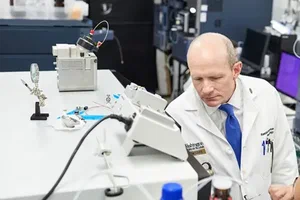
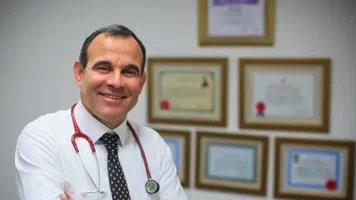
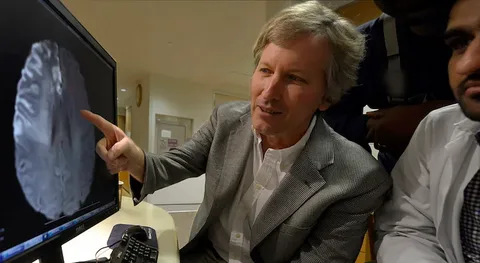
A team of scientists—including Agnieszka Ciesielska (left), Barbara Klein (center), and Jeanne Paz (right)—showed that modified stem cells can improve brain activity, even when administered more than a month after a stroke. Credit: Michael Short/Gladstone Institutes
Every 40 seconds, someone in the United States has a stroke. For survivors of the most common type of stroke, called an ischemic stroke, only about 5 percent fully recover. Most others suffer from long-term problems, including weakness, chronic pain, or epilepsy.
Now, scientists at Gladstone Institutes and the regenerative medicine company SanBio have shown that a cell therapy derived from stem cells can restore normal patterns of brain activity after a stroke. While most stroke treatments must be administered in the immediate hours after a stroke to have a benefit, the cell therapy was effective in rats even when given one month later.
“There are currently no treatments that can be given weeks or months after a stroke to prevent long-term symptoms, so this is incredibly exciting,” says Gladstone Investigator Jeanne Paz, Ph.D., who led the new study published in Molecular Therapy. “Our findings suggest that this timepoint is not too late to intervene and make a difference.”
The modified stem cells used in the study have been in clinical development for more than a decade to treat stroke and traumatic brain injuries. Clinical trials had already indicated that, in some patients, the stem cells could help people regain control of their arms and legs. However, scientists were unsure what changes in the brain contributed to these improvements in symptoms.
The new study is the first to detail the effects of the stem cells on brain activity. The work could lead to improvements to stem cell therapy and contribute to the development of other treatments with similar impacts on the brain.
Targeting Brain Hyperexcitability
An ischemic stroke occurs when blood flow to part of the brain is blocked, usually due to a blood clot or narrowing of blood vessels. This deprives brain cells of oxygen and nutrients, causing some cells to die and others to change their activities.
Paz has long studied the brain changes that result from strokes and lead to long-term problems such as epilepsy. She and others have found that cells in damaged brain regions can become overly active or hyperexcitable, sending out signals that are too strong or too frequent to other brain regions.
“This hyperexcitability has been linked to movement problems and seizures, but no therapies have been developed to effectively reverse it,” says Paz, who is also an associate professor in the Department of Neurology at UC San Francisco and a member of the International Post-Stroke Epilepsy Consortium, which aims to accelerate discoveries to prevent the development of epilepsy after stroke.
Striking Effects
In the new study, Paz and her collaborators tested a stem cell therapy under development by SanBio. One month after rats had a stroke, the scientists injected the modified human stem cells into the animals’ brains near the site of injury. In the following weeks, they measured electrical activity in the brains and also analyzed individual cells and molecules.
They found that the treatment reversed brain hyperexcitability in rats with strokes, restoring balance in neural networks. In addition, a number of proteins and cells that are important for brain function and repair were increased.
While fewer than one percent of the human cells remained in the rats’ brains after a week following the transplant—the effects of the transplants were long-lasting.
“It seems these cells are essentially jump-starting the brain’s own repair processes,” says Barbara Klein, Ph.D., a principal scientist at SanBio and first author of the new study. “This may open a new window of opportunity for the brain to recover, even in the chronic phase after a stroke.”
The scientists also analyzed blood samples from the rats with and without the stem cell therapy. Through this, they identified a specific combination of molecules in the blood—including many involved in inflammation and brain health—that changed after a stroke but were restored to normal by the therapy.
“These effects were so striking that we repeated the experiments over and over because we didn’t quite believe them,” says Paz. “It’s incredible that you can inject something short-lived into the brain and have lasting effects—not only on brain hyperexcitability, but also in the rest of the body.”
Shaping Future Treatments
The researchers say that the most exciting lesson from the new study is that, even one month after a stroke, treatments have the potential to restore normal excitability in the brain.
“This tells us there may be hope for chronic brain injury patients who, until now, did not have any treatment options,” says Agnieszka Ciesielska, Ph.D., a postdoctoral researcher in Paz’s lab at Gladstone, who is another first author on the study.
However, more work is needed to prove that the diminished hyperexcitability induced by the stem cells ultimately leads to reduced symptoms in patients. If it does, additional treatments could be developed to calm overactive neurons.
The team also hopes to eventually gain a better understanding of how exactly the stem cells improve brain functions. If they can pinpoint a few molecules that play key roles, they may be able to develop small-molecule drugs that mimic the effects of the stem cells.
The cells used in the study, known as SB623 cells, have been developed by SanBio for the treatment of chronic neurological motor deficits secondary to both stroke and traumatic brain injury. The treatment was recently approved in Japan for improving chronic motor paralysis following traumatic brain injury. SanBio is also pursuing indication expansion and seeking approval from the US Food and Drug Administration.
More information: Barbara Klein et al, Modified human mesenchymal stromal/stem cells restore cortical excitability after focal ischemic stroke in rats, Molecular Therapy (2024). DOI: 10.1016/j.ymthe.2024.12.006
Journal information: Molecular Therapy
Provided by Gladstone Institutes
Explore further
Enhancing the efficacy of cell transplantation therapy for stroke or traumatic brain injury
Facebook
Feedback to editors
Featured
Last Comments
Popular
Very low LDL-cholesterol correlates to fewer heart problems after stroke
20 hours ago
0
LSD microdosing reduces depression scores without major side effects, clinical trial finds
22 hours ago
0
Symptom-free H5N1 infection in humans: Evidence remains scarce
23 hours ago
0
Newly discovered RNA molecule could limit protein aggregation and prevent neuronal damage
Nov 12, 2025
1
Physical inactivity and food insecurity emerge as key diabetes predictors in Southern California adults
Nov 11, 2025
0
Extreme age protects against cancer in mouse study
1 hour ago
Current cannabis blood concentrations used to identify impaired drivers could land innocent people in jail
1 hour ago
Veteran suicide rates are declining, but remain high for those with brain injuries, research shows
2 hours ago
Genes may predict suicide risk in depression
4 hours ago
Cellular protein FGD3 boosts breast cancer chemotherapy and immunotherapy, study finds
13 hours ago
Common gout drug may reduce risk of heart attack and stroke
13 hours ago
Wearable ultrasound sensor delivers noninvasive treatment with adjustable, body-conforming design
13 hours ago
Extending anti-clotting treatment linked to lower rates of new clots
14 hours ago
High blood pressure in children nearly doubled from 2000–2020, global study finds
14 hours ago
Alzheimer’s risk calculator could spot danger years before symptoms begin
14 hours ago
Your Health Matters
The Biggest Smile, Rejuvenated Gums & Better Breathe
Prodentim
Get Semaglutide or Tirzepatide (Ozempic & Mounjaro)
Direct Meds
Is Alzheimer’s Disease Genetic?
HealthDay News